
Research into Mediumship: Terminology, Publication and Progress 29 August 2026 – Posted in: Reflections – Tags: #MediumPennyHayward #Mediumship #DrAgneseVenskus #Consciousness #Cognition #Research #StateOfAwareness #EEG #Alpha-Band #SenseOfAgency #TemporalBindingWindow #IndividualAlphaFrequency
Research into mediumship continues to face challenges within mainstream academic publishing, particularly around terminology and how mediumistic experiences are conceptualised and described.
For mediums, this can sometimes create a sense that the lived experience being investigated is not fully represented in the language ultimately used in academic publications. This is one reason why building trust and genuine collaboration between mediums and researchers is so important.
As a medium myself, I am keen to help build that bridge. I have recently started a Master’s in Consciousness, Spirituality and Transpersonal Psychology and have also been developing relationships with academic researchers interested in scientifically investigating these experiences, including psychologist and EEG researcher Dr Agnese Venskus.
Dr Venskus recently published a study examining behavioural and neural differences between individuals who did and did not report mediumship states. The study investigated three main areas: temporal sensitivity, sense of agency, and alpha-band brain activity measured using EEG. The findings showed that the mediumship states group had broader temporal binding windows (TBWs). A temporal binding window refers to the period of time within which sensory information is likely to be integrated and experienced as belonging to the same event. They also demonstrated broader sense of agency (SoA) windows, meaning that the period over which an outcome could be associated with one’s own action was wider in this group. Importantly, differences were also observed in EEG activity. At rest, participants from mediumistic state group showed higher posterior alpha power and a higher individual alpha frequency (IAF) than the comparison group. These findings suggest relatively stable differences in alpha-band neural dynamics between the groups.

Me wired up about to have my brainwaves measured
A subset of participants also completed EEG recording while intentionally entering what they personally recognised as mediumistic state. Exploratory analysis found that individual alpha frequency increased during this active state compared with rest, suggesting that alpha dynamics may also change depending on experiential state. These findings are particularly interesting because they provide objective behavioural and neurophysiological evidence that people reporting mediumistic state differ from comparison participants on specific measures of perception, agency and neural activity.
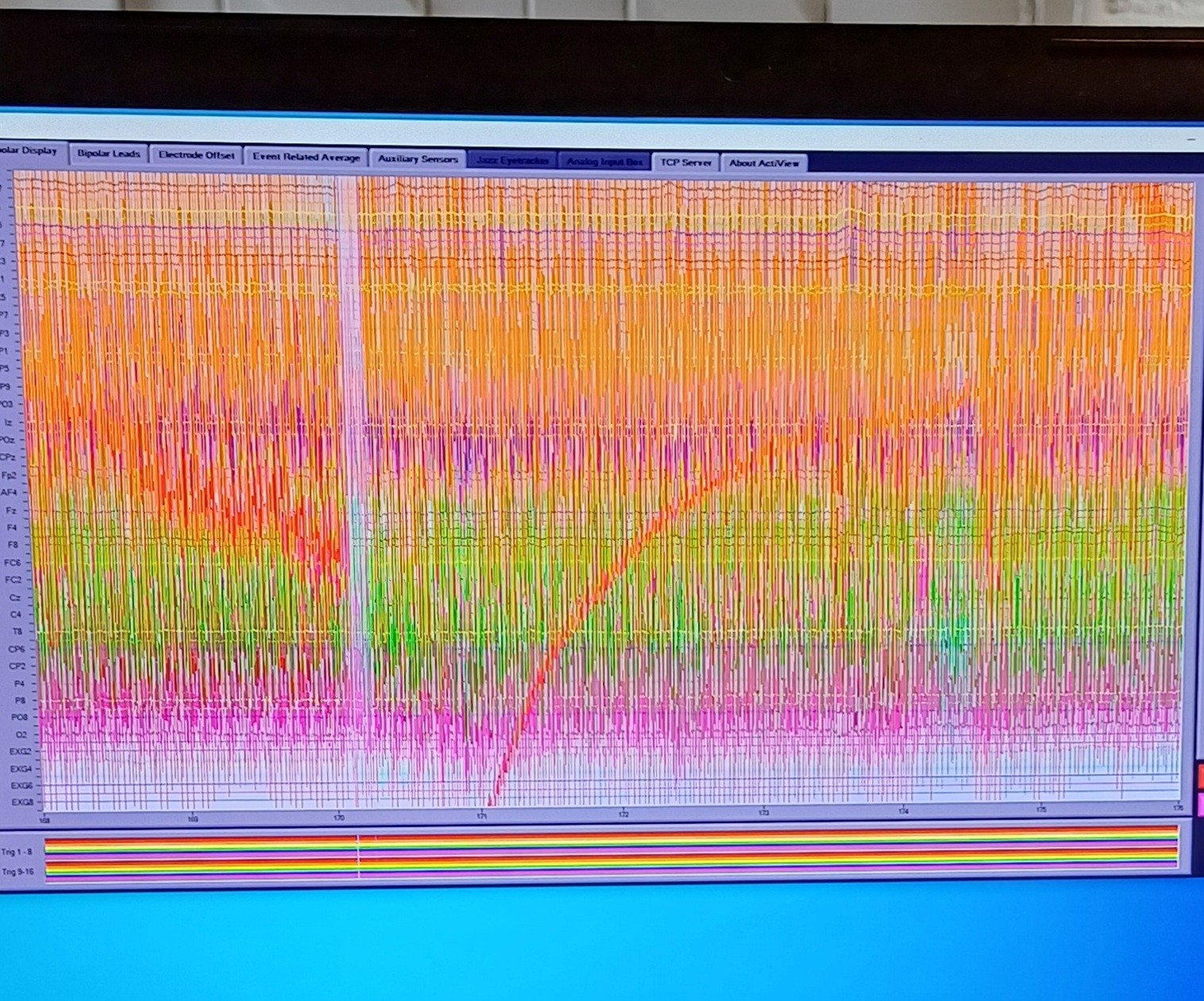
My brainwaves before testing begins
However, it is also important to be clear about what this research does and does not demonstrate. The study was not designed to establish whether mediumistic communication itself is genuine, nor does it identify a neurological mechanism that can be described as the cause of mediumship. Rather, it demonstrates measurable differences associated with people who consistently report these experiences. That distinction is important scientifically and provides a foundation for further research.
For me personally, the state recorded during the second condition was recognisable as the same state of awareness I use when practising evidential mediumship. This is my interpretation of my experience as a participant and should be distinguished from the conclusions that can formally be drawn from the scientific data.
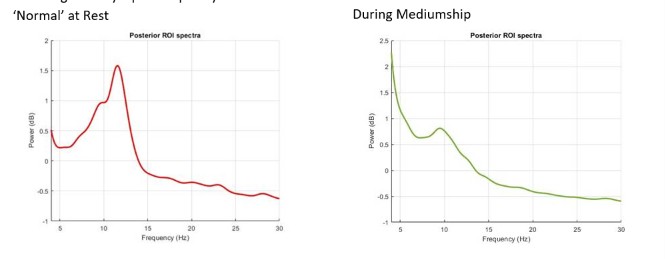
My Alpha wave at rest and during mediumship
The research has now been peer reviewed and published in Consciousness and Cognition, a mainstream academic journal: Venskus, A. (2026). Temporal integration and alpha oscillatory dynamics in individuals reporting persistent ESP-like experiences. Consciousness and Cognition, 141, 104059. https://doi.org/10.1016/j.concog.2026.104059
The published paper uses the broader scientific term “ESP-like experiences” rather than describing the group simply as “mediums.” While this terminology may not fully reflect how some participants understand or describe their own experiences, publication of research of this kind within a mainstream psychology journal is nevertheless an important step.
As one of the participants, I can confirm that when I was asked to enter the experimental “active ESP-like state,” I intentionally entered the state of awareness that I personally use for evidential mediumship. I also know a number of other mediums who contributed to this research, and their participation has been invaluable.
Rather than seeing this publication as an endpoint, I see it as an important beginning. Rigorous research, combined with respectful dialogue between researchers and experienced mediums, provides an opportunity to investigate mediumistic experiences scientifically without dismissing the lived experience of the people being studied. There is much more research to come. Stay tuned.